
If you’ve ever loved the idea of clip-in extensions—but hated the thought of a bulky ridge, visible tracks, or an itchy scalp—seamless clip in hair extensions are worth understanding.
This guide is written for beginners. By the end, you’ll know:
what “seamless” actually means
why some clip-ins look obvious (and how to avoid that)
how to put them in so they feel secure and look natural
how to care for human hair clip in extensions so they stay soft longer
Seamless clip-ins use a thinner, flatter weft base—often easier to hide, especially on fine hair.
The best install is all about sectioning + grip: start at the nape, work up, and keep wefts away from your hairline.
“100% human hair” doesn’t always mean high quality—look for clearer signals like Remy and cuticle alignment.
Washing less often, brushing gently, and storing properly does more for longevity than buying extra products.
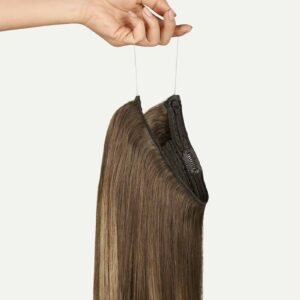
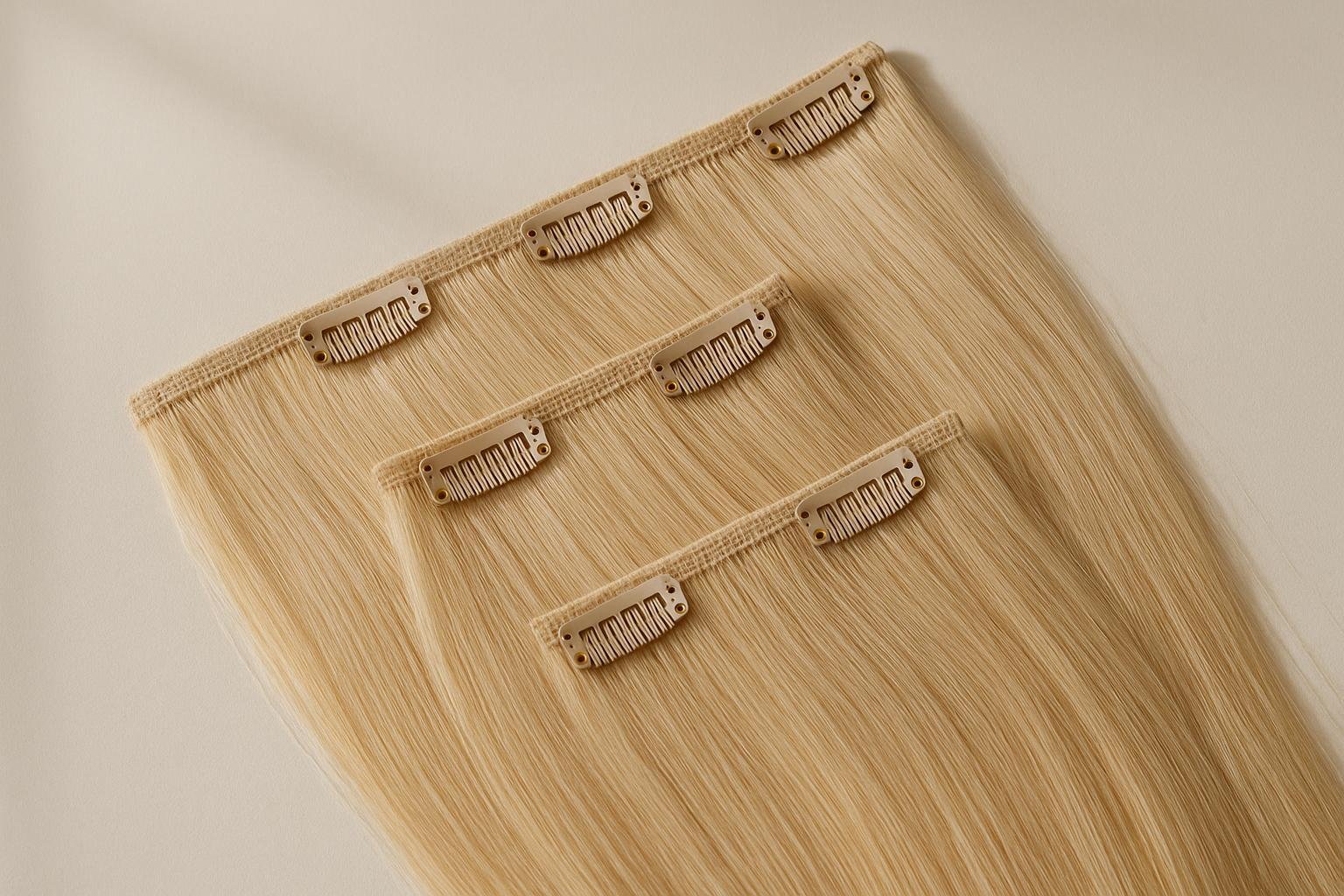
Seamless clip-ins are a type of temporary hair extension made from (usually) human hair. The “seamless” part refers to the base (also called the weft)—it’s designed to be ultra-thin and flexible so it sits flatter against your head.
Many retailers describe seamless wefts as having a thin PU/silicone-style base that helps the weft lie close to the scalp for a more discreet finish (for example, see Cliphair’s explanation in Everything About Seamless Hair Extensions).
A few quick terms you’ll see:
Weft: the strip the hair is attached to.
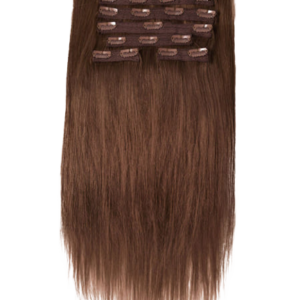
Clips: small snap clips sewn onto the weft; they open and close to grip your natural hair.
Remy hair: real human hair collected to keep cuticles aligned in one direction (more on why that matters below).
Key Takeaway: “Seamless” is about the base—a thinner, flatter weft that’s easier to hide, especially if your hair is fine.
Classic clip-ins usually have a thicker stitched seam at the top of the weft. That can be totally fine—especially if you want a lot of volume—but it may feel bulkier.
Here’s the simple difference most beginners actually care about:
What you’re deciding | Seamless clip-ins | Classic/double-weft clip-ins |
|---|---|---|
How flat they sit | Flatter, lower profile | Often thicker at the seam |
Best for | Fine-to-normal hair, sleek styles | Normal-to-thick hair, maximum volume |
Comfort | Often feels lighter | Can feel heavier depending on set |
Look at the root | More discreet when placed well | Can show more if hair is fine |
Trade-off | Often pricier | Often more budget-friendly |
For a retailer-style overview of the pros/cons framing, see Cliphair’s Seamless Clip-Ins vs Double Weft Clip-Ins Pros & Cons.
1) A more natural blend for fine hair
If your hair is on the finer side, bulky seams can be the thing that gives extensions away. Seamless wefts are designed to reduce that “bump” so blending is easier—especially in half-up styles.
2) Comfort for all-day wear
A low-profile base can feel less “there” on your scalp, particularly if you’re wearing clip-ins for workdays, weddings, or long events.
3) Sleeker styles are easier
If you like straight hair, low ponytails, or smooth blowouts, seamless wefts typically sit flatter—so you don’t have to fight the shape of the weft.
1) You may get less root volume
Because seamless wefts are designed to lie flat, they don’t always create the same “lift” at the root as thicker wefts.
2) They can cost more
Some brands note seamless sets may be more expensive due to additional processing and construction (see HairExtensions.co.uk: Seamless hair extensions vs traditional hair extensions).
If you’re searching “how to apply clip in extensions,” you’re usually trying to solve one of two problems:
they slip
they show
This method helps with both.
Brush your hair fully (tangles make placement harder).
If your hair is very silky, add a tiny bit of texture (dry shampoo or light hairspray at the roots).
Start at the nape of your neck and work up in horizontal sections.
A practical walkthrough of sectioning and working from bottom to top is outlined in HairExtensions.co.uk’s Step-by-step guide: how to put in clip-in hair extensions.
Light backcombing (gentle teasing) right at the root gives the clips something to hold.
Pro Tip: If your clip-ins slide, it’s usually a grip problem—not a “bad extensions” problem. Add texture at the root before blaming the weft.
Open all clips on a weft.
Place the weft close to the root (not pulling tight).
Snap each clip shut.
Repeat, moving upward.
Most visibility issues happen when wefts are placed too close to the hairline.
As a rule of thumb:
Keep wefts at least 2–3 fingers away from your temples.
Avoid clipping directly at the crown if you wear your hair flat.
Leave enough hair on top to fully cover the weft seam.
⚠️ Warning: If anything feels painful or tight, take it out and reposition. Clip-ins shouldn’t cause scalp pain.
Gently brush the surface layer to blend.
If you use heat, apply heat protectant.
For the most natural finish, curl your natural hair and extensions together (even a soft bend helps them “merge”).
This is where beginners get burned—because many products are marketed with the same labels.
Fine hair: seamless wefts are often easier to hide; don’t overload your head with too many wefts at once.
Thicker hair: you can wear seamless too, but you may prefer thicker wefts if your goal is maximum volume.
A big buying trap is assuming “100% human hair” automatically means high quality.
Some extension educators warn that when a product is labeled “100% human hair” without clearer quality markers like Remy, it can still be lower-grade, more tangle-prone hair (see BarelyXtensions: Comparing Extensions: Remy, Non-Remy, Virgin & Synthetic).
Cuticle alignment matters because misaligned cuticles can increase friction—one reason some extensions tangle quickly.
Cliphair’s education piece on the role of hair cuticles in extension quality explains why cuticle direction and condition can affect smoothness and tangling.
Does the listing clearly say Remy (not just “human hair”)?
Is the hair described as cuticle-aligned or “cuticle intact”?
Are there clear photos of the weft/base so you can see how thin it is?
Is there a returns policy and real review detail (not just star ratings)?
If you want to see an example of what a seamless set looks like in a listing, you can reference this internal page: seamless clip-in human hair extensions.
If you’re Googling “how to care for clip in hair extensions,” the biggest mindset shift is this:
Your extensions don’t get scalp oils the way your natural hair does. So they usually don’t need frequent washing.
Many brands recommend washing clip-ins only after multiple wears (often around every 10–15 wears, depending on product build-up and styling).
Follow the manufacturer’s instructions for your specific set, but in general:
Detangle before washing.
Use lukewarm water.
Smooth shampoo down the hair length (don’t scrub it like you’re washing your scalp).
Condition the mid-lengths to ends; avoid soaking the clips/weft.
For a conservative baseline routine, Cliphair’s hair extension care instructions cover brushing and general handling.
Brush from the ends upward.
Hold the hair above where you’re brushing so you don’t stress the weft.
Detangle before storing.
Even high-quality human hair extensions can dry out faster than your natural hair.
Use heat protectant.
Keep temperatures moderate.
If you can, rotate in heatless styles (braids, rollers).
Storage is where good sets die early.
Close the clips.
Lay the hair flat (or store in a bag/box).
Keep them cool and dry, away from direct sunlight.
For more help, here are internal resources to keep going:
It’s usually better to remove clip-ins before sleeping. Sleeping with clips in can create tension on your hair and increase tangling.
It’s not recommended. Chlorine and salt water can dry hair out fast, and wet hair tangles more easily. If you need hair for a holiday look, consider removing clip-ins before swimming and restyling after.
They can—because the weft sits flatter—but placement matters. Use fewer wefts, keep them away from the hairline, and focus on grip at the root.
It depends on hair quality and how often you wear and heat-style them. If you wash infrequently, detangle gently, and store them properly, they can last significantly longer than sets that are heat-styled daily.
If you want to explore options or see what a seamless base looks like up close, these internal pages can help:
Browse the seamless clip-in extensions collection
Explore the broader human hair extensions collection