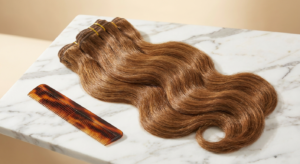

Picking a blonde isn’t just “going lighter.” It’s choosing a shade that agrees with your skin’s undertone—so your features look brighter, your complexion looks clearer, and the color reads intentional (not brassy, flat, or slightly off).
If you’ve ever searched blonde hair color undertone charts and still felt unsure, you’re not alone. Most “rules” fail because they ignore dimension, maintenance, and how color behaves next to your natural base.
This guide will help you figure out your undertone fast, shortlist the most flattering blonde families, and (if you wear extensions) choose blonde hair extensions that actually blend in real life.
Key Takeaway: The right blonde works with your undertone. The wrong blonde fights it—and that’s when hair looks yellow, harsh, or dull.
Your undertone is the “warm/cool/neutral” tone under your skin—it stays consistent even if you tan.
Warm undertones usually look best in golden/honey/caramel blondes.
Cool undertones usually look best in ash/platinum/icy blondes.
Neutral undertones can go either way, but beige/sandy/dimensional blondes are the safest bet.
The most natural-looking blonde is rarely one flat color. Dimension (root shadow + highlights/lowlights) makes blonde look real.
For extensions, match your mid-lengths and ends (not your roots), and choose multi-tonal shades when possible.
Undertone is the quiet “base color” under your skin. It’s different from surface tone (fair/medium/deep) and it doesn’t change much over time.
1) Vein test (natural light, inside wrist)
Greenish veins → usually warm
Blue/purple veins → usually cool
Hard to tell / mixed → often neutral
2) Jewelry test
Gold looks best → usually warm
Silver looks best → usually cool
Both look equally good → often neutral
3) Sun reaction (general pattern, not a rule)
You tan easily → often warm
You burn easily → often cool
If you’re between two answers, treat yourself as neutral and choose a balanced blonde (beige, sandy, soft dimensional).
Here’s the buyer-guide part: pick the blonde family that supports your undertone first, then decide how light you want to go.
Warm undertones tend to look best with blondes that carry golden, honey, caramel, and beige warmth—think “sunlit,” not “yellow.”
Most flattering warm-blonde families
Golden blonde
Honey blonde
Caramel blonde
Beige blonde (warm-leaning)
Bronde (brown + blonde)
Why it works: your hair echoes the warmth already in your complexion, so your skin looks more luminous instead of washed out.
Common mistake: going too icy/ashy all over. On warm undertones, that can make skin look slightly gray or flat. If you love cooler blondes, keep some warmth through the mid-lengths or as subtle lowlights.
Cool undertones usually look best with blondes that read clean, bright, and low-yellow.
Most flattering cool-blonde families
Ash blonde
Platinum blonde
Icy blonde
Cool beige blonde
Why it works: cool blondes can make the complexion look crisp and polished, especially if you have pink/rosy undertones.
Common mistake: “warm blonde because it looks natural.” If the warmth is too strong, it can pull orange/yellow against your skin. The fix isn’t always “go darker”—often it’s just better toning and a more neutral shade.
Neutral undertones are the easiest to shop for because you can wear both warm and cool shades.
Safest neutral-blonde families
Beige blonde
Neutral blonde
Sandy blonde
Soft dimensional blonde (multi-tonal)
If you’re indecisive, go dimensional. The mix of tones reads believable and is usually easier to maintain.
A blonde that looks expensive usually has one thing: depth.
Natural blonde hair is rarely one solid color. It has variation—brighter pieces, softer pieces, and usually a slightly deeper root area.
Your natural root is darker than your blonde goal
You’re growing out old highlights or balayage
You want a blonde that looks good in photos (not “wig-flat”)
Root shadow / root melt for softer grow-out
Face-framing highlights
Lowlights to add richness (especially if hair looks overly pale)
Pro Tip: If you’re choosing extensions, “dimension” is your friend. Multi-tonal blondes typically blend more naturally than a single flat color.
Extensions don’t need to be a perfect named shade match. They need to blend once they’re in your hair. In other words, a good blonde hair extensions color match is about undertone + dimension + placement—not obsessing over the label on the box.
Extensions sit with your lengths. If your roots are darker (super common), matching roots can make your ends look too dark or muddy.
If your natural hair has highlights, a flat extension shade is harder to blend convincingly.
A slightly lighter match is usually easier to soften with toning than a too-dark match is to brighten.
A colorist can often tone extensions lightly to shift the warmth/coolness, so you don’t have to panic over a “perfect out-of-the-box match.”
If you want the most “disappears into your hair” finish: seamless clip-in hair extensions
If you want quick volume with minimal clips: halo human hair extensions
If you want a traditional, structured option: classic clip-in hair extensions
If you want an easy up-do upgrade: ponytail hair extensions
Even a perfect blonde can shift warmer over time—especially after sun, heat styling, and frequent washing.
Purple helps cancel yellow tones
Blue helps cancel orange tones
Use a purple (or blue) toning shampoo 1–2x per week as needed (overuse can dull shine or feel drying).
Consider a gloss/toner refresh every 6–8 weeks if your blonde changes quickly.
Keep hair hydrated (lightened hair usually needs more moisture).
⚠️ Warning: If your blonde is already very light, toning products can grab quickly. Start with shorter contact time and build up.
If you want the shortest path to a flattering blonde:
Warm undertone → start with honey/golden/bronde.
Cool undertone → start with ash/beige-cool/platinum.
Neutral undertone → start with beige/sandy/dimensional.
If you’re deciding between warm and cool families, this is the simplest rule: warm vs cool undertones blonde should generally match (warm hair with warm skin, cool hair with cool skin). If you deliberately break the rule for a fashion look, keep dimension so your complexion doesn’t look washed out.
And if you’re buying extensions, your safest move is choosing a shade that blends with your mids and ends—then letting a colorist fine-tune tone if needed.
For a natural, everyday blend, start here: seamless clip-in hair extensions.
Use this when you’re about to book a color appointment or add blonde extensions to your cart:
I know my undertone: warm / cool / neutral.
I chose a blonde family that matches it (golden vs ash vs beige).
I’m adding dimension (or choosing dimensional extensions) so it looks real.
I’m matching extensions to my mids/ends.
I have a brass-management plan (purple vs blue).
The best blonde hair color for your skin tone comes down to three things:
Know your undertone
Pick a blonde family that matches it (not fights it)
Build dimension so the result looks natural
Whether you’re going full platinum, adding sun-kissed highlights, or shopping extensions, don’t aim for “perfect on paper.” Aim for believable in your lighting.
If you want a low-risk start, bring your shade shortlist (plus a few selfies in natural light) to a colorist—and if you’re ordering extensions, match your mids/ends first, then fine-tune tone.

Last Updated on 07/02/2026 by Lindsey